
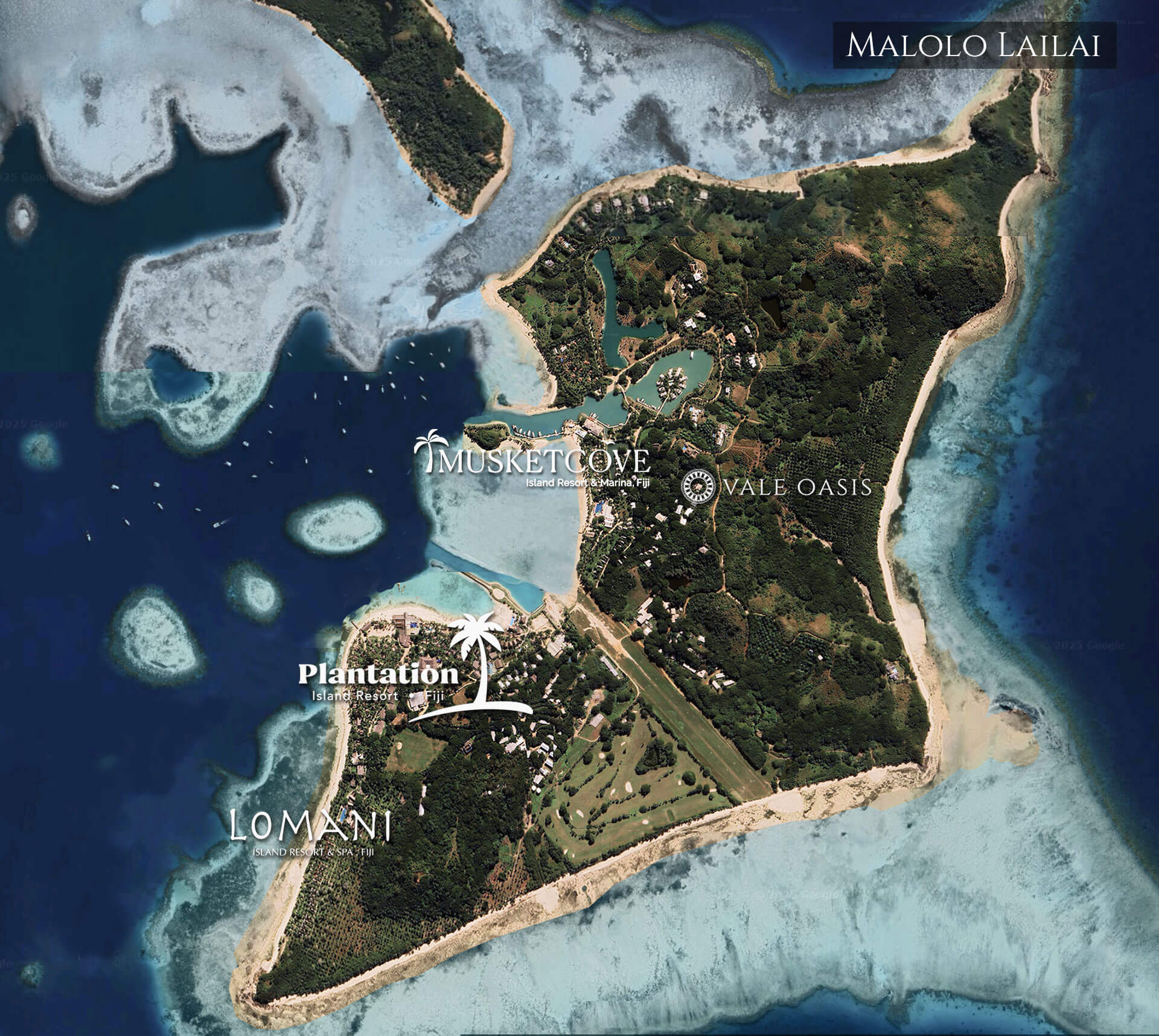
Malolo Lailai (Little Malolo) is 600 acres of rich volcanic land surrounded by 9.3 km of pristine white-sand beaches and stunning tropical reefs. The island is home to three popular resorts, a number of residential houses, a marina and yacht club, a nine-hole golf course, an airstrip, a sheltered harbour and anchorage, a small supermarket, various boutique shops, a medical centre, a day spa, a salon, multiple bars, cafés and restaurants, incredible people, plus a vast range of tourist facilities, activities and excursions.
Located 20 km north-west of Nadi, off the coast of Fiji's main island, Viti Levu, Malolo Lailai is the most developed and second-largest island of the Mamanuca Group. The larger island of Malolo lies off the northernmost point of Malolo Lailai, separated by a small isthmus that can be crossed at low tide.
Malolo Lailai can be reached in 50 minutes from Port Denarau by the Malolo Cat ferry with three scheduled services daily.
Malolo Lailai is the only freehold land in the Mamanuca Islands. Indeed, freehold land for tourism development is extremely rare anywhere in Fiji. This has enabled private enterprise to prosper on Malolo Lailai without the limitations associated with leasing from traditional landowners.
It began as an ancient caldera, releasing lava like molasses folding from a spoon. Palm trees had yet to appear. The faraway glaciers melted, and water filled Malolo Bay, seeding life with a propensity for paradise in its DNA.
The uninhabited island of Malolo Lailai was sold by Nadroga chief Ratu Kini to cotton grower John Thomson.
Thomson died four years later, and ownership passed to American entrepreneur Louis Armstrong. When Armstrong went bankrupt, the island reverted to the Mortgage Agency of Australasia.
In November 1891, plantation magnate James Borron bought the island. He then granted a 70-year lease to the Chinese Wong Ket family to cultivate coconut palms and produce copra.
Richard “Dick” Smith, Reginald “Reg” Raffe, and Sir Ian MacFarlane jointly acquired Malolo Lailai, adding an airstrip, private homes, and guest lodges.
The three partners split their landholdings and Reg Raffe opened Plantation Village (now Plantation Island Resort) with ten bures.
Dick Smith focused on developing Musket Cove, then called Dick's Place, welcoming its first guests on 3 October 1975 with 12 traditional bures. The Resort’s restaurant, Dick’s Place, honours him and the original name.
Sir Ian MacFarlane sold his share to Smith and Raffe. The consolidated 400 acres (162 ha) support the original coconut plantation plus organic agriculture supplying produce to the island’s resorts.
Reg Raffe's children, Reardon, Barron, Jayson and Hannah, established Lomani Resort, a boutique luxury resort for adults only on the western point of the island.
Dick Smith lived on the island until his passing in July 2012, aged 81.
Reg Raffe passed away in January 2014, aged 89.
Everything you see on Malolo Lailai today is thanks to these two great men. Their achievements are carried forward by the next generation of Smiths and Raffes, who grew up on the island and continue to carry on their fathers' legacies.
Malolo Lailai is home to three popular resorts.
Each resort caters to a distinct market. Their proximity to one another along the protected western side of the island means you can enjoy the beachfront amenities and restaurants of all three.
The largest is Plantation Island Resort with around 180 units. The resort is aimed primarily at families with young children. There's a daily kids' club, three swimming pools, an enclosed swimming lagoon and water park, a nine-hole golf course, a snack bar, shops and three restaurants (serving kids' meals at 5:00 pm, followed by movies). For kids, there's a continuous stream of organised activities to keep them busy from sunrise to bedtime. The beachfront is the best on the island with plenty of palm-tree shade and swimming at all tides.
The island's newest resort, Lomani Island Resort and Spa, is adjacent to Plantation with 15 spacious suites. Lomani has a no-children policy, adding peace and quiet to its sedate and luxurious atmosphere. With exquisite food, unique cocktails and five-star service, Lomani is an experience in sophisticated leisure and tranquillity.
The island's premier resort is Musket Cove Island Resort and Marina set partly along inland waterways. The lagoon bures are built with verandas over the water and offer spacious modern living and air conditioning. The garden villas offer larger, split-level accommodation and are ideal for families. The beachfront and garden bures are more traditional thatched-roof bungalows with local vibes. The palm-fringed cove overlooks a protected lagoon that drains at low tide, making swimming off the main beach a tidal affair. The Resort occupies the largest part of the island, including its highest peaks and many tracks. You can spend days exploring its beaches, hilltop walks, plantations, bush, grasslands and coral reefs.